
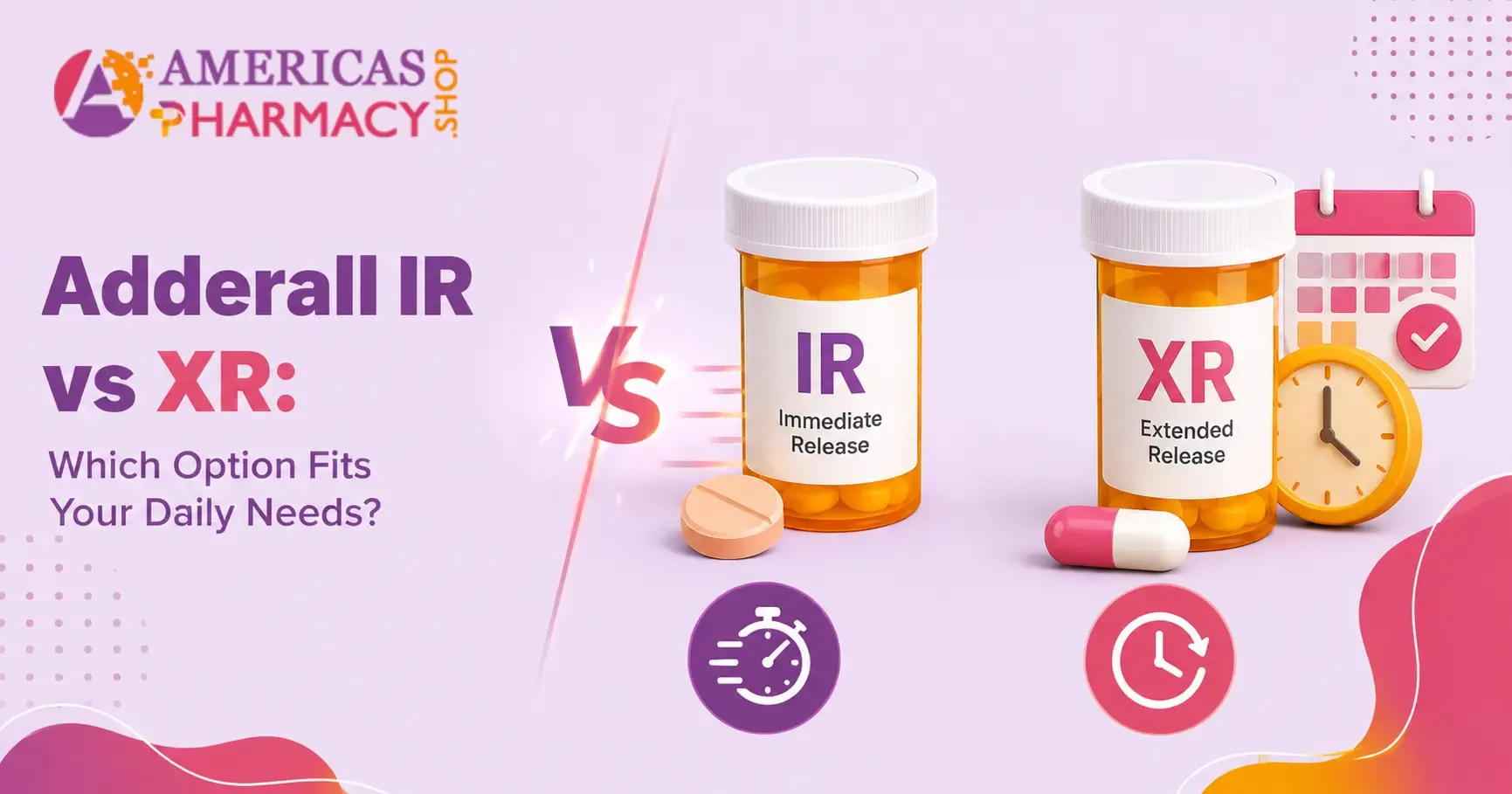
Choosing the right ADHD medication schedule can be challenging, especially when patients compare Adderall IR vs XR. Both medications are commonly discussed for ADHD management, but they are not identical. The main difference lies in how they release the medication and how long the effects may last during the day.
Many patients ask whether it is better to take Immediate Release (IR) or Extended Release (XR). The answer often relies on job schedules, study habits, symptom patterns, and medical advice.
Here’s a guide to Adderall IR versus XR, explaining how each form works, its differences, potential benefits, and factors to consider to help you decide which better meets your daily needs.
Understanding Adderall and Its Role in ADHD Treatment
Adderall is a prescription drug that is commonly used as a part of treatment for ADHD. It works by altering a number of brain chemicals critical for attention, focus and impulse control.
Healthcare providers may recommend different formulations depending on:
- Duration of symptom control needed
- Daily activity schedules
- School or work commitments
- Individual response to treatment
- Previous medication history
When comparing Adderall IR to XR, patients usually choose a shorter duration of action with flexible dosage or extended coverage throughout the day.
Both formulations contain identical active ingredients, but their delivery mechanisms differ.
What Is Adderall IR?
Adderall IR stands for Immediate Release. This version releases the medication shortly after it is taken. Because of this faster release pattern, many patients notice effects earlier than with extended-release formulations.
The effects generally do not last as long as XR, which means some individuals may require more than one dose throughout the day under medical supervision.
Features of Adderall IR
Some common characteristics include:
- Faster release into the body
- Shorter duration of symptom coverage
- Possible need for multiple daily doses
- Greater flexibility for timing adjustments
- Easier dose customization in certain cases
Patients with fluctuating schedules often discuss Adderall IR versus XR, as IR offers the flexibility that some schedules require.
For example, someone working only part of the day may not need all-day coverage. In those situations, shorter action may sometimes be considered.
What Is Adderall XR?
Adderall XR means Extended Release. This formulation is designed to release medication gradually over time instead of all at once.
The goal of XR is to provide longer symptom support during the day with fewer doses.
Many people prefer XR because it often fits structured routines such as:
- Hours of full-time work
- Hours in school
- Classes in college
- Long hours of study
- Work environments
Some people take it once in the morning rather than numerous times a day.
Key Characteristics of Adderall XR
Adderall XR may offer:
- Extended symptom control
- Reduced dosing frequency
- More convenience during busy days
- Steady release patterns
- Support for longer activities
When discussing Adderall IR vs XR, patients frequently choose XR when convenience becomes important.
Feature |
Adderall IR |
Adderall XR |
Release Type |
Immediate release |
Extended release |
Dosing Frequency |
Often multiple doses |
Usually once daily |
Onset Speed |
Faster |
Gradual |
Duration |
Shorter coverage |
Longer coverage |
Flexibility |
Higher |
Moderate |
Adderall IR vs XR for Working Professionals
Timing of symptoms affects productivity; people who are highly occupied at work usually talk about comparing Adderall IR vs XR.
When XR May Be Helpful
XR is frequently discussed by people who:
- Work standard office hours
- Attend long meetings
- Travel during workdays
- Need continuous focus
- Prefer fewer medication interruptions
A single morning dose may reduce the need to remember additional doses later.
When IR May Be Considered
IR sometimes attracts individuals who:
- Shorten working hours
- Have alternating schedules
- Require symptom control at times
- Preferred customizable time
Adderall IR vs XR for Students and Academic Performance
Students have extensive periods of focus, homework, projects, and exams. Consequently, many will debate Adderall IR vs XR before talking about therapy options.
Benefits Students Often Seek in XR
Extended release options may fit students who need:
- Coverage during full school days
- Support through lectures
- Reduced interruptions
- Better consistency between classes
Some college students with busy schedules desire lengthier doses of activity.
Situations Where IR May Be Discussed
Immediate release options may be considered for:
- Evening study groups
- Flexible class hours.
- Academic part-time schedule
- short attention spans required
The choice depends heavily on how symptoms affect daily performance.
Lifestyle Factors That Influence Adderall IR vs XR Decisions
Lifestyle is a big factor in choosing medication regimes.
Here are some of the most frequently asked questions:
Do You Need All-Day Support?
People who remain active from morning until evening may discuss XR more often.
Is Flexibility Important?
Patients whose days change frequently sometimes ask providers about IR.
Are You Comfortable Taking Multiple Doses?
Some individuals prefer one daily dose. Others do not mind separate dosing schedules.
Does Work or School Require Continuous Focus?
Long commitments may influence discussions around extended coverage.
Comparing Adderall IR vs XR becomes easier when patients evaluate how symptoms appear during normal activities.
Potential Side Effects and Safety Considerations
As with many prescription drugs, both the IR and XR formulations might have harmful consequences.
Commonly discussed effects include:
- Loss of appetite
- Dry mouth
- Trouble sleeping
- Higher heart rate
- Anxiety, nervousness
- Headache
- Nervousness
- Upset stomach
Not everyone experiences side effects in the same way.
Patients should always:
- Follow prescribed instructions
- Avoid self-adjusting doses
- Report unusual symptoms
- Discuss medication interactions
- Attend regular medical follow-ups
Medication safety is especially important when evaluating Adderall IR vs XR, as the dosing schedules differ.
Adderall IR vs XR: Which Option May Fit Different Daily Routines?
Here are some instances that could illustrate how differences in lifestyle may impact talks about medications.
Office Employee
A 9 AM to 5 PM worker might require symptom support for longer periods of time.
College Student
A student with lectures, assignments, and evening study sessions may need longer help.
Potential conversation: XR.
Freelancer or Remote Worker
Someone who works for only a few hours daily would like flexibility.
Talk topic: IR.
Shift Worker
Workers with variable schedules typically require flexible timing.
Possible subject for discussion: IR.
These examples are not intended as therapy suggestions. They’re only demonstrating that Adderall IR and XR rely on different habits.
Common Questions About Adderall IR vs XR
Is Adderall XR stronger than IR?
Not necessarily. The major difference is release timing rather than strength.
XR releases gradually while IR works more quickly.
Can patients switch from IR to XR?
Changes should be made solely by healthcare providers. There is no advice on switching your own drugs.
Does IR work faster?
IR is generally designed for faster release compared with XR.
Is XR more convenient?
Many people find XR convenient because it often involves fewer doses.
Which lasts longer?
XR is designed for extended coverage compared with immediate-release formulations.
Important Things to Discuss With a Healthcare Provider
Before choosing between Adderall IR vs XR, patients may want to discuss:
- Daily schedules
- Work demands
- Academic responsibilities
- Sleep patterns
- Previous medication experiences
- Existing medical conditions
- Other medications are being used
These discussions help create more personalized treatment approaches.
Adderall IR vs XR and Long-Term Medication Planning
Treatment strategies might alter over time.
Someone who starts with flexible requirements may need extended coverage later. Similarly, XR users could someday also talk about varied timetables.
Medication planning often evolves because:
- Jobs change.
- School routine changes
- Symptoms vary.
- Lifestyle expectations are rising
- Medical reactions are diverse
That’s why talking to your healthcare providers is still really vital.
Final Thoughts
The Adderall IR versus XR debate continues, as each formulation serves a distinct purpose. Immediate Release alternatives offer flexibility and a faster onset, while Extended Release options are designed to last longer and require less frequent dosing.
It’s not that one is better than the other. The correct one relies on lifestyle, job demands, academic timetables, symptom timing, and professional medical advice.
Patients considering ADHD treatment should focus on understanding how their daily routine works and discuss those needs with licensed healthcare providers.
Selecting between Adderall IR vs XR becomes easier when treatment decisions are based on medical guidance rather than convenience alone.